4/07/2010

Visible & Invisible


Anamorphic Man
2006
A three dimensional anomorphic projection. When viewed through the circle on the left the figure becomes whole.
Location - Private Collection, Seoul, Korea
Size - 1100mm x 450mm x 250mm
Materials - Brazed steel
Photo - John Coombes


The Anamorphic Man will be born if you look from a central viewing point (wiry hole) a figure is visible. 
'Anamorphic Man' was specially comissioned for "Assembling Bodies: Art, Science & Imagination"by The Museum of Archaeology and Anthropology, Cambridge University through Kinetica Museum. 
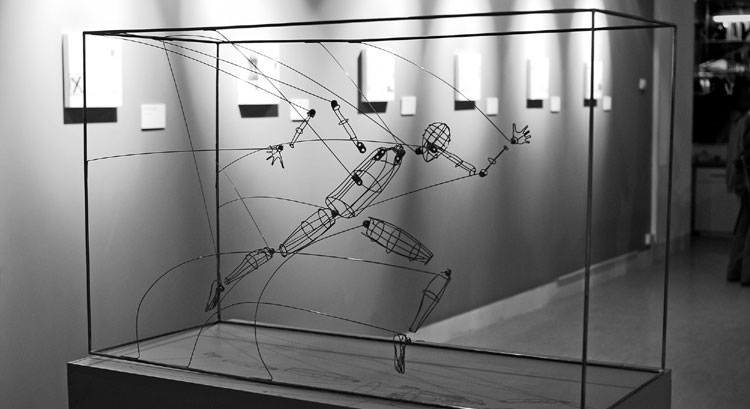
 
                                                                       Giant Leap
2005
A dislocated figure stretches apart as he leaps through time and space.
Location - Private Collection, Edinburgh
Dimensions - 1000 X 500 X 300 mm
Materials - Brazed mild steel
Photo - John Coombes


Anamorphic Man, Museum of Archaeology & Anthropology, Cambridge


Atomised
2005
A leg is propelled into space stopping with a jolt, its foot still shaking. From the other side the other leg joins it in the centre. Piece by piece a figure is formed in space and suspended in time.
Location :Collection of Kinetica Museum, London. Currently exhibited at the Museum of Anthropology and Archeology, Cambridge University.
Materials - Steel, Motors, plc, sensor
Size :3000 X 2100 mm
Photo - John Coombes


I have to say though that those works are not so spacial, i do like the style. A simple space was make up by iron ropes. Black Lines are so vivid and persuasive, which can attract audience easily. It is like a kid game "Visible & Invisible".


The Teatro Olimpico


THE Teatro Olimpico is the last work by Palladio, and ranks amongst his highest masterworks, which was designed for the Vicenza Accademia Olimpica to stage theatrical performances.

JY,(GreatBuildings.com)described that Inside an exterior brick box, the elaborate wooden theater interior is a half circle of steep tiers of seats (wood covered benches) facing a rectangular proscenium stage. A wooden colonnade with cornice and figures above circles the top of the seats. The ceiling plane is undifferentiated and was later painted blue, suggesting an open sky above the theater.


The walls and ceiling of the proscenium are elaborately articulated with architectural details and statues, made of wood and plaster. A central arched opening dominates the back wall, flanked by two smaller doorways. Through these openings, elaborate stage sets of streets angle backstage, a triad through the central opening and single streets through each side. These sets, designed later by Scamozzi, use techniques of tilting the floors and contracting the angle between the street walls and the heights of their building facades to make foreshortened streets in perspective.


The picture above is Italy Pavilion in Expo 2010 Shanghai China.

Designer used Palladio's Teatro Olimpico( a part of gate) as the mark of Italy.

I drew a plan to explore the vision inside, which succeeding generations adopted the proscenium arch and painterly stage sets.


For me, The  innovations of the building is  starting with eliminating the rigid and unchangeable scaenae frons and the unchanging perspective views. 
As a English architect Inigo Jones visited the Teatro Olimpico shortly after its completion, and took careful notes, in which he expressed particular admiration for the perspective views: "[T]he chief artifice was that whear so ever you satt you sauw one of thes Prospects...."


OH..  it's a biiiig issue!  let me think abt it more..


4/06/2010

Anamorphosis


THESE images were created on a pen plotter sometime in the late 70's (I don't remember the year). They are examples of anamorphic images: that is, they are distorted so that the original (undistorted) images will appear when viewed in an unusual manner. 

The images below are cylindrical anamorphic distortions. If you were to look at the reflection in a cylindrical mirror held to the circle at the top of the image, you would see the original (undistorted) image. A short length of chrome pipe from the hardware store works quite well. 
By James Arvo (arvo@cs.caltech.edu)
Firstly, the umbrella one is called conical mirror:

              
Vewed looking into the top of the cone.


                                                                                                                   Viewed from the side.

There is a mechanical device ("pantograph")
for creating this kind of anamorphosis
by tracing over an original image.


Secondly, this is another example looks simple but impress :


   Spock , 2007, 1102 spools of thread, 
stainless-steel ball chain and hanging apparatus, clear acrylic sphere, metal stand (44.5 x 36 x 60 inches)

I feel that the former one of SPOCK series has similar principle with Ames chair, the chrome Semi-sphere as eyes reflections the view that was distorted.

3/26/2010

The first chair model

PerhapsAmes is best known for constructing illusions of visual perception, most notably the Ames room and the Ames window. 

The lady face is me, when i chat about Ames chair with my a artist friend who drew this picture for helps me to understand the principle.  
 

2: See the picture from slope view,the face becomes my real shape... Not so fact like that..

At the beginning I thought the Ames chair was three-dimensional, because the picture is not clear and the explanation somewhat vague but after reflecting I realised it was bi-dimensional. Based on the picture of the Ames chair, I drew some drafts to make model.


I used drinking straws, thread and putty to make the model. It’s like a magic when I finished and check it from bottom view.
My next plan is make more this kind of models for develop Ames idea, more special and interesting.


Sunshine in French National Library ~~


In the Paris trip, I visited the Bibliotheque nationale de France(French National Library ).
It's really wonderful library !! 
The great architecture was exiting. Especially the mini forest 
inside the library itself. With thoughts about misleading visual perception in mind,i noticed an interesting effect of light and shadow in the form of a stright ray of light that appears to cut through the trees, this can only be appreciated from a certain angle, as you move away from this spot the line becomes less perfect.


3/25/2010

Oh, Ames chair..

This IS Ames room,
follow the room,my following work is following CHAIR..


 I was stare at the Ames chair picture a loooog time, and many times, it's quite
difficult to understand how it works. I google the odd chair, search it from library..  
Finally, i knew it!! It's a such amazing invention. Simple but impressed.
There are some quotations, which talk about the background of Ames chair.

By Roy R. Behrens


1/21/2010

1+1= 1


 The picture is very interesting!
  Stereo vision produces new illusory contours.
  One of the winner from "6th Annual Best Visual Illusion of the Year".
 Design by Davi Geiger & Hiroshi Ishikawa.
  
The perception of the Kanizsa illusory triangle (first row) is strengthened by stereo matching. Does stereo matching use illusory contours as features for matching? Does stereo matching produces new illusory contours?
Stereo vision may not match illusory contours and (new) Illusory contours can be formed after stereo matching occurs (second row).
so,i call it "1+1= 1" lol
I think maybe it is hint something about a new space that could be created by our eyes in this ways?  Coooool ?  I don't know.. let me keep thinking.

Information got from
http://illusioncontest.neuralcorrelate.com/cat/top-10-finalists/2009/#post-1064    


Mind Frame


Afterimage Mind Frame' is a visual installation where the audience discovers and recreates images in empty picture frames. Physical, mental, and emotional interaction all come together in this piece.
The work called "Mind Frame" which was made by korea artist Jaewook Shin.


The visitor is invited to hang any of five frames on a wall. In each, they see an abstract moving image composed of white dots. After the array of dots stops moving, an afterimage of a familiar painting is revealed in the otherwise blank frame. 
The moving dots create a more complex afterimage, 'exposing' the eye like a camera to create darker and more vivid areas. The most fascinating part of this phenomenon is that they don't see just the afterimage, but a combination of the afterimage and the original painting from their own memory.
This is rare work so far i found made by afterimage.


The boundary's of science and art are blurring?

It is really coincident !
Before i choose my subject "afterimage" i use Olafur Eliasson's work ---"The weather project" as my favorite architecture in 5 things.
Anyway, the coincidence is when i search informations about afterimage, i found a video which is a short presentation by Olafur Eliasson again. 
His talk is.....a little bit boring but helpful for me.


Olafur Eliasson: Playing with space and light.

An illusion room


The famous space called:  Ames room.
It is created by an American ophthalmologist Adelbert Ames, Jr. (1880–1955), who first constructed such a room in 1946. And his idea was come from a concept by the German physicist Hermann Helmholtz in the late 19th century.An Ames room is depicted in the 1971 film adaptation of the Roald Dahl novel Charlie and the Chocolate Factory. Also, production of The Lord of the Rings film trilogy used several Ames room sets in Shire sequences to make the heights of the hobbits correct when standing next to Gandalf.


The Ames room looks cubic when seen with one eye through a specially-positioned peephole.


However, the room's true shape is trapezoidal. " The floor, ceiling, some walls, and the far windows are trapezoidal surfaces; the floor appears level but is actually at an incline (one of the far corners being much lower than the other); and the walls are slanted outward, though they seem perpendicular to the floor. This mistaken shape makes it look as if people or objects grow or shrink as they move from one corner of the room to another. "


   Definition from Wikipedia.

1/09/2010

A video about George Rousse

George Rousse, a French photographer.
His work is could be called anamorphic art, only viewable in its intended focus from one precise viewpoint. It's no business about after image or optical illusion but quite interesting. Maybe i can get some inspirations from him.

Let's have a look~!

1/08/2010

12/09/2009

Optical Illusion

< Eyes, lie, illusions > is a great and intriguing book, it arose my interesting for optical illusion,
which relate to such broad areas beyond my anticipation.
Now I understood the reason that Pete always lead me to explore it.


Just at the beginning of the book, i got lots of useful key words,
which quite worth to think about it.
And also, i researched some other data form world book.

I choose four famous pictures about optical illusion.
( Unfortunatly, i don't know why the quality of pixs always be bad when i post on blogger....-.- But i can see it so clear was saved from PS. Maybe is cause the blogger compress it automatic. )


Well..
Recently, i'm reseach two sorts of optical reactions made of after image:
Illusion and delusion (hallucination? i'm not sure how to call it more accurate ),
they are similar but different.
I want to display the delicate difference between illusion and delusion through After Image.
How does influence for a space could be.
It is necessary to research the different intention of Illusion and delusion in existent works,
such as some architectures and installation art.

And also, optical illusion that refers to an image continuing to appear in one's vision after the

exposure to the original image has ceased.

In the spatial restrictive field, what condition should be use corresponding between

Illusion and delusion?

To me, the trend of delusion is erratic, abstract and perceptual, as a dream,
while the Illusion is like a magic, odd outside but rational and well-founded inside.

关注者