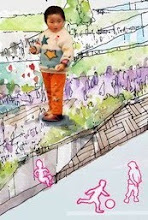
Perhaps, 3/26/2010
The first chair model
Perhaps, Sunshine in French National Library ~~
3/25/2010
Oh, Ames chair..
1/21/2010
1+1= 1
Stereo vision may not match illusory contours and (new) Illusory contours can be formed after stereo matching occurs (second row).
Information got from:
http://illusioncontest.neuralcorrelate.com/cat/top-10-finalists/2009/#post-1064
Mind Frame
Afterimage Mind Frame' is a visual installation where the audience discovers and recreates images in empty picture frames. Physical, mental, and emotional interaction all come together in this piece.
The work called "Mind Frame" which was made by korea artist Jaewook Shin.
The boundary's of science and art are blurring?
Before i choose my subject "afterimage" i use Olafur Eliasson's work ---"The weather project" as my favorite architecture in 5 things.
Anyway, the coincidence is when i search informations about afterimage, i found a video which is a short presentation by Olafur Eliasson again.
His talk is.....a little bit boring but helpful for me.
Olafur Eliasson: Playing with space and light.
An illusion room
The famous space called: Ames room.
It is created by an American ophthalmologist Adelbert Ames, Jr. (1880–1955), who first constructed such a room in 1946. And his idea was come from a concept by the German physicist Hermann Helmholtz in the late 19th century.An Ames room is depicted in the 1971 film adaptation of the Roald Dahl novel Charlie and the Chocolate Factory. Also, production of The Lord of the Rings film trilogy used several Ames room sets in Shire sequences to make the heights of the hobbits correct when standing next to Gandalf.
The Ames room looks cubic when seen with one eye through a specially-positioned peephole.
However, the room's true shape is trapezoidal. " The floor, ceiling, some walls, and the far windows are trapezoidal surfaces; the floor appears level but is actually at an incline (one of the far corners being much lower than the other); and the walls are slanted outward, though they seem perpendicular to the floor. This mistaken shape makes it look as if people or objects grow or shrink as they move from one corner of the room to another. "
Definition from Wikipedia.
1/09/2010
A video about George Rousse
His work is could be called anamorphic art, only viewable in its intended focus from one precise viewpoint. It's no business about after image or optical illusion but quite interesting. Maybe i can get some inspirations from him.
Let's have a look~!
12/09/2009
Optical Illusion
< Eyes, lie, illusions > is a great and intriguing book, it arose my interesting for optical illusion, which relate to such broad areas beyond my anticipation.
Now I understood the reason that Pete always lead me to explore it.


I choose four famous pictures about optical illusion.
And also, optical illusion that refers to an image continuing to appear in one's vision after the
exposure to the original image has ceased.
In the spatial restrictive field, what condition should be use corresponding between
Illusion and delusion?
11/08/2009
Five Things
http://www.youtube.com/view_play_list?p=


Cremaster 1 by Matthew Barney
To be honest, i can't understand well what the meaning of it want to expression. But,anyway,i like it cause if you zoom in thses things, some subtle and interesting changes on the center of it.


Belonging by Jeannie Baker
A new book from Jeannie Baker is also a much anticipated event and this book, Belonging is no exception. This time Jeannie Baker tackles head on the urban environment and what a statement she makes. This book, wordless, tells such an intense story that you will be glued to the pages to discover the changes over time in the incredibly detailed collage pictures.
This book is a joy to read and look through, I loved the little touches like the changing signs and the objects around the window depicting the change of time.


Architecture
The weather project by Olafur Eliasson
The subject of the weather has long shaped the content of everyday conversation. The eighteenth-century writer Samuel Johnson famously remarked ‘It is commonly observed, that when two Englishmen meet, their first talk is of the weather; they are in haste to tell each other, what each must already know, that it is hot or cold, bright or cloudy, windy or calm.’ In The Weather Project, the fourth in the annual Unilever Series of commissions for the Turbine Hall, Olafur Eliasson takes this ubiquitous subject as the basis for exploring ideas about experience, mediation and representation.